
Manueline Architecture at Jerónimos: A Detailed Visual Guide
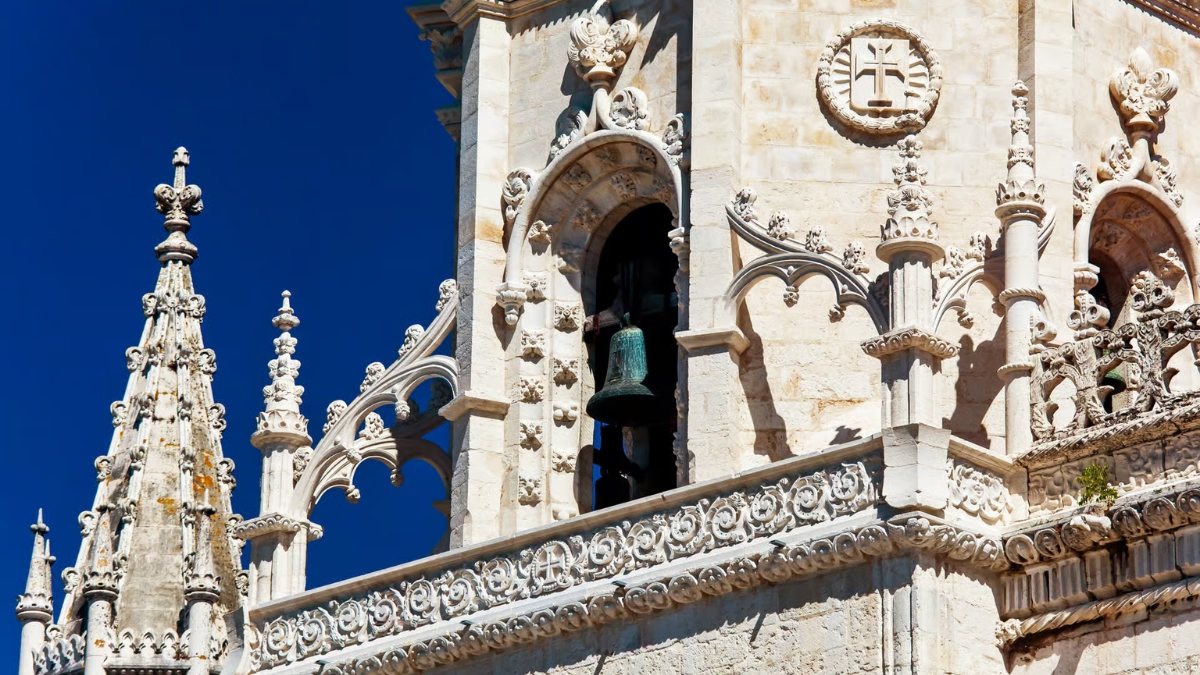
Manueline is Portugal’s late Gothic style from the early 1500s, named for King Manuel I and built largely on wealth from the maritime spice trade. At Jerónimos it shows up as stone carved into ropes, knots, armillary spheres, the cross of the Order of Christ, coral and shells, and exotic plants — a maritime vocabulary layered onto a Gothic frame. The densest concentration is at the South Portal, followed by the cloister arcades and the church’s ribbed vaulting.
Jerónimos Monastery is the single best place in the world to see Manueline architecture, because it was built specifically to showcase it. The style doesn’t replace Gothic structure so much as dress it in carved rope, sea creatures, and royal emblems, turning stone into a record of Portugal’s Age of Discovery.
This guide explains what Manueline architecture actually is, who built it, the symbols worth learning to recognize, and exactly where at Jerónimos to find the best examples.
What Is Manueline Architecture?
Manueline is a Portuguese architectural style of the early 16th century, essentially a late flowering of Gothic structure combined with exuberant, maritime-themed decoration. It takes its name from King Manuel I, under whom Jerónimos was built, and it flourished for only a few decades before Renaissance forms took over.
Manueline (Manuelino in Portuguese) is not a wholly new structural system — it keeps the pointed arches, ribbed vaults, and buttressed logic of Gothic building. What changes is the surface. Portals, columns, window frames, and vault ribs are carved with an obsessive, naturalistic ornament drawn from the sea: ropes, knots, anchors, coral, shells, and plants and animals that Portuguese sailors were encountering for the first time on new trade routes to Africa, India, and Brazil. It is decoration as propaganda — a stone record of a small kingdom that had just become a maritime superpower, and King Manuel I made sure the message was carved everywhere his money was spent.
The style is named for Manuel I (“the Fortunate”), who reigned from 1495 to 1521 and used the fortune pouring in from the spice trade to fund an ambitious building program. Jerónimos, begun in 1501, is its flagship monument: construction was largely financed by a tax on spices and other goods from Portugal’s overseas trade, so the building is, quite literally, made of money earned at sea — which is part of why the sea shows up everywhere in its carving.
Manueline architecture was short-lived. It flourished for roughly the first three decades of the 16th century and had mostly given way to classical Renaissance forms by mid-century, which makes Jerónimos — where construction spanned about a century and the style transitions before your eyes as you move through the complex — an unusually complete place to study it.
The Architects: Boitaca and João de Castilho
Jerónimos was designed first by Diogo de Boitaca, who laid out the church and began the cloister around 1501, and then largely executed by João de Castilho, who took over roughly a decade later and is responsible for most of the monastery’s richest Manueline carving, including the South Portal.
Two architects shaped what you see today. Diogo de Boitaca established the plan of the church and cloister and is credited with pioneering the Manueline style itself; his early work set the template of slender piers and elaborately carved surfaces that later architects would build on. João de Castilho then took charge of the project and carried it through its most productive and most decorated phase, overseeing the cloister’s arcades, much of the church’s vaulting, and the South Portal’s dense figural sculpture. Later still, as the Renaissance took hold in Portugal, other builders introduced more restrained classical elements into parts of the complex — one reason the monastery reads, section by section, almost like a timeline of Portuguese architecture across the 16th century.
Reading the Symbols: A Visual Vocabulary
Manueline carving is not random ornament — it is a fairly consistent set of motifs, and once you can name them, the monastery becomes much easier to “read.” Look for:
- Armillary spheres — a globe-like navigational instrument that Manuel I adopted as his personal emblem. It appears throughout Jerónimos as a shorthand for royal patronage and Portugal’s mastery of ocean navigation.
- The Cross of the Order of Christ — a distinctive cross with a smaller cross cut into its center, the emblem that Portuguese ships carried on their sails. It signals the crown’s fusion of religious and maritime authority.
- Twisted ropes and knots — carved as if the stone itself were rigging, running along cornices, window frames, and balustrades in imitation of a ship’s cordage.
- Sea creatures and coral-like forms — carved as if pulled straight from the ocean floor, reinforcing the maritime theme in stone that would otherwise be structural and plain.
- Shells — a recurring decorative motif, often clustered near portals and column capitals.
- Exotic flora and fauna — plants, fruits, and animals unfamiliar to European eyes, inspired by the new lands and trade routes Portuguese sailors were opening up in Africa and Asia.
None of this is applied at random. It clusters most densely at the building’s most symbolically important points — the main entrances and the church’s structural climax — which is exactly where to concentrate your attention on a visit.
Where to Spot the Best Examples
The three richest concentrations of Manueline detail at Jerónimos are the South Portal (the most elaborate carved entrance), the two-story cloister arcades and columns (the most sustained and varied decorative program), and the ribbed vaulting inside the church (where the maritime motifs meet full Gothic structure overhead).
The South Portal
The South Portal is Jerónimos’s single most photographed piece of stonework and the best place to start. Attributed largely to João de Castilho, it stacks tiers of niches, pinnacles, and canopies around a statue of Henry the Navigator, with archivolts crowded with saints, angels, and the twisted-rope and armillary-sphere motifs that define the style. It rewards slow looking: the closer you get, the more detail resolves out of what first reads as simple ornamental busyness.
The Cloister Arcades and Columns
The two-story cloister is where Manueline carving is most sustained — every arcade, corner, and column carries some variation of rope, knot, botanical, or heraldic motif, so it repays a slow full circuit rather than a quick pass. Look closely at the corner piers and the tracery infilling the arches, where lace-like stonework turns structural elements into pure ornament without losing the underlying Gothic geometry.
The Church Vaulting
Inside the church of Santa Maria de Belém, look up. The nave’s net-like ribbed vaulting is supported on slender, almost palm-tree-like columns that seem too thin for the stone canopy they carry — a hallmark Manueline effect that prioritizes visual drama over visible structural bulk. The rib patterns overhead echo the twisted-rope motif found at ground level, tying the building’s exterior and interior vocabulary together.
How Manueline Differs from Pure Gothic or Renaissance
Manueline keeps a Gothic building’s pointed arches and ribbed vaults but drowns them in maritime, naturalistic ornament that pure Gothic architecture never used; it differs from the Renaissance that followed by favoring dense, asymmetrical, narrative carving over the Renaissance’s calm symmetry and revival of classical columns and pediments.
Pure Gothic architecture, whether in France or elsewhere in Europe, is disciplined: pointed arches and ribbed vaults are usually left structurally legible, with ornament kept relatively restrained and religious in theme. Manueline takes the same Gothic skeleton and piles on a specifically Portuguese, specifically maritime decorative program — ropes, spheres, coral, and exotic plants that have no equivalent in French or English Gothic. It is denser, more narrative, and unmistakably tied to one country’s moment of oceanic expansion rather than to a pan-European tradition.
Renaissance architecture, which took hold in Portugal not long after Manueline peaked, moves in the opposite direction: it favors symmetry, restraint, and the revival of classical columns, pediments, and rounded arches over Gothic verticality and maritime clutter. At Jerónimos, you can sense this shift in the later stages of construction, where decoration grows calmer and more classically proportioned compared to the exuberance of the South Portal and cloister — a reminder that Manueline was a brief, transitional style rather than a long-lived architectural tradition.
A What-to-Look-For Walk-Through
For a first visit focused specifically on the architecture, this order works well:
- Start outside at the South Portal before joining the ticket queue. Pick out the armillary spheres and the Cross of the Order of Christ near the statue of Henry the Navigator, then trace the archivolts outward to spot the rope-like carving framing the whole composition.
- Enter the church first (it’s free and has its own line) and look straight up at the nave vaulting. Notice how the ribs fan out from unusually slender columns — a deliberately theatrical Manueline effect.
- Move into the ticketed cloister and walk a full circuit rather than cutting across. Slow down at the corners and column capitals, where the carving is most varied, and compare the ground-floor arcade to the more delicate upper story.
- Look for repetition versus invention. Ropes and knots repeat almost everywhere; shells, coral, and exotic flora vary from bay to bay, rewarding visitors who actually stop to compare details rather than photograph and move on.
Budgeting extra time for this kind of close looking is worthwhile — most visitors move through the cloister faster than the carving deserves, so allow more than a quick walk-through if the architecture itself is your main interest.
Frequently Asked Questions
What does “Manueline” mean?
Manueline refers to a Portuguese architectural style from the early 16th century, named after King Manuel I, under whose reign Jerónimos and other major monuments were built. It is essentially a late Gothic style layered with maritime-themed carving — ropes, armillary spheres, and exotic flora and fauna — reflecting the wealth and imagery of Portugal’s Age of Discovery.
Who designed the Manueline decoration at Jerónimos?
Diogo de Boitaca began the church and cloister around 1501 and is credited with originating the Manueline style, while João de Castilho took over construction roughly a decade later and executed most of the monastery’s richest carving, including the South Portal. Later architects introduced more classical, Renaissance-influenced elements as the building program continued across the century.
What do the ropes and knots carved into the stone represent?
The twisted-rope and knot motifs found throughout Jerónimos evoke a ship’s rigging, tying the building’s decoration directly to the maritime trade that funded its construction. They appear on cornices, window frames, columns, and vault ribs, often running continuously as if the stone itself were cordage.
What is an armillary sphere and why is it everywhere at Jerónimos?
An armillary sphere is a navigational instrument representing the celestial globe, and King Manuel I adopted it as his personal emblem. Its frequent appearance at Jerónimos marks the building as a royal project and celebrates Portugal’s navigational achievements during the Age of Discovery.
Where is the best Manueline carving at Jerónimos?
The South Portal is generally considered the single richest example, with its dense tiers of carved figures, canopies, and maritime motifs. The two-story cloister arcades offer the most sustained decorative program to study at length, and the church’s ribbed vaulting shows how the style extends into full Gothic structure overhead.
Is Manueline the same as Gothic architecture?
No, though it’s closely related. Manueline keeps a Gothic building’s pointed arches and ribbed vaults but adds a distinctly Portuguese, maritime-themed layer of ornament — ropes, shells, coral, and exotic plants and animals — that standard European Gothic architecture does not use.
How long did the Manueline style last?
Manueline flourished for roughly the first three decades of the 16th century before giving way to Renaissance forms, which favored calmer, more classical proportions. Because Jerónimos took about a century to complete, parts of the complex show this transition from dense Manueline ornament toward more restrained, later styles.
Do I need a guide to appreciate the architecture, or can I self-guide it?
Either works. A guided tour can point out details and context you might otherwise miss, but this guide’s walk-through — South Portal, church vaulting, then a slow circuit of the cloister — works well for self-guided visitors who take their time rather than rushing through.
