
Church of Santa Maria de Belém: What to See Inside Jerónimos
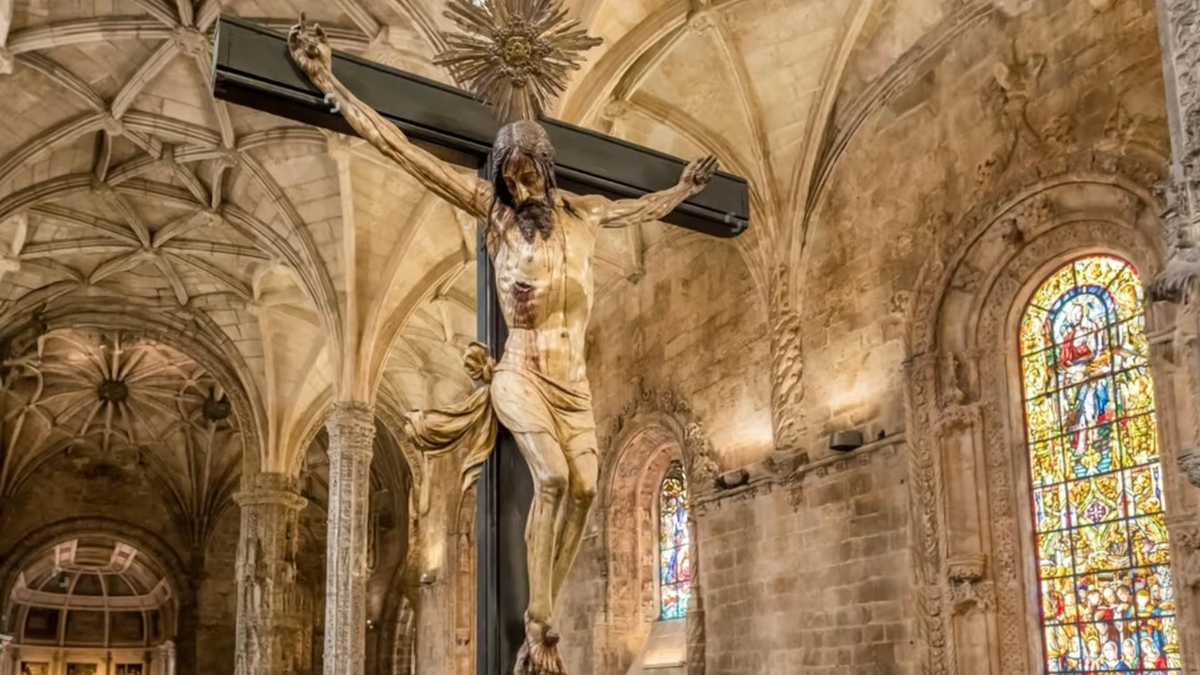
The church of Santa Maria de Belém is the free half of Jerónimos Monastery — no ticket needed. Inside, slender octagonal columns rise into an intricate net of Manueline vaulting that survived the 1755 earthquake almost untouched, opening onto a single, unbroken hall of space. Highlights include the main chapel with the tombs of King Manuel I and King João III, the raised choir, and the tombs of Vasco da Gama and Luís de Camões flanking the entrance.
Most visitors queue for the ticketed cloisters and never realize the church next door is free, separately entered, and just as worth seeing. Where the cloisters impress with carved stone courtyards, the church impresses with scale: one soaring, uninterrupted volume, lit from high windows, built to make a wealthy 16th-century kingdom feel small.
This guide covers what to look for inside the church of Santa Maria de Belém — the architecture, the tombs, the portals — plus what you need to know before you go.
What Makes the Church Interior So Striking
The church is built as a hall church, meaning its nave and two side aisles rise to nearly the same height, so no lower side aisles or heavy dividing arches break up the view. Slender octagonal columns, carved by João de Castilho to resemble palm trunks, carry an elaborate net and rib vaulting overhead. That vaulting survived the devastating 1755 Lisbon earthquake largely intact, unlike much of the city around it.
Step through the free entrance and the first thing you notice is the absence of a clear boundary between nave and aisles. That’s the hall-church design: rather than a tall central nave flanked by lower side aisles, all three run up to roughly the same height, so the space reads as one continuous room rather than three separate ones. It’s an unusual choice for a church of this scale, and it’s a large part of why the interior feels so open.
Holding that ceiling up are rows of tall, slender columns, octagonal in cross-section and carved with the twisting, rope-like ornament typical of the Manueline style — Portugal’s own Late Gothic idiom, tied to the wealth of the maritime spice trade that paid for the building. Overhead, the ribs branch and cross into an intricate net vaulting, more decorative and complex than a typical Gothic groin vault. It’s worth knowing that this ceiling has already survived the worst test Lisbon could throw at it: the catastrophic earthquake of 1755, which leveled large parts of the city, left the church’s vaulting largely standing. Look up before anything else — the vaulting is the single detail people remember longest.
The Main Chapel and the Royal Tombs
The main chapel, at the far end of the church, is where the monastery’s royal patrons ended up at rest. King Manuel I, who commissioned the building in 1501, and his successor King João III are both entombed here, together with their queens, in tombs added some decades after the church itself was finished. Look for the carved stone elephants supporting the royal tombs — an unmistakable nod to the overseas empire and the exotic trade routes that funded the monastery in the first place.
The chapel sits at a slightly different architectural register than the rest of the church, more Renaissance in feel than the Manueline nave, a reminder that the building took roughly a century to complete and passed through more than one artistic hand along the way.
The Raised Choir
Turn back toward the entrance and look up: a raised choir gallery spans the width of the church above the west door, reached by its own staircase and originally used by the monastery’s resident monks for the daily offices. The choir stalls up there are carved in a more restrained Renaissance style, a useful contrast with the exuberant Manueline carving below. Many visitors miss it entirely because it sits behind them as they walk in — it’s worth the turn.
The Tombs of Vasco da Gama and Luís de Camões
Just inside the entrance, at ground level, two stone tombs flank the doorway: navigator Vasco da Gama on one side and poet Luís de Camões on the other. Da Gama’s sea route to India helped fund the monastery’s construction, and Camões later celebrated that voyage in Portugal’s national epic poem, “Os Lusíadas” — so the pairing at the door is a deliberate piece of national storytelling, not a coincidence of geography. These tombs were added in the 19th century, well after the men themselves lived, as part of a wave of national commemoration rather than as their original burial sites. Our dedicated guide to the tombs of Vasco da Gama and Luís de Camões goes into more detail on both figures and the carving on each tomb.
The South and West Portals
Two carved doorways are worth studying from both sides of the wall. The South Portal, facing the river, is the church’s showpiece exterior: a tall, densely sculpted composition of saints, pinnacles and canopies attributed largely to João de Castilho, centered on a statue of Henry the Navigator. The West Portal, facing Praça do Império and the square, is generally attributed to Nicolau Chanterene and carries scenes from the life of St. Jerome, the hermit-scholar for whom the Hieronymite monks — and the monastery itself — are named. Step outside after your visit to see both from the square before you move on.
Visiting the Church: What to Know Before You Go
The church is free and has its own entrance and queue, separate from the ticketed cloisters. It keeps shorter hours than the cloisters and can close without much notice during Mass or other services. Dress modestly — shoulders and knees covered — since it remains an active place of worship.
A few practical points separate a visit to the church from a visit to the cloisters:
- It’s free, with no ticket, timed slot or booking required.
- The entrance and line are separate from the ticketed cloister entrance — don’t queue in the wrong line by mistake.
- Hours are shorter than the cloisters’, and the church can close at short notice for Mass or other services; see our guide to Jerónimos Monastery’s opening hours for the current schedule.
- Dress modestly. As an active church, it expects covered shoulders and knees; our dress code guide covers what to wear and what to avoid.
- It’s a fast visit compared to the cloisters — most people spend 15–20 minutes here, which makes it easy to combine with a same-day cloister visit if you buy the entrance ticket for the courtyard and museums next door.
Even if a full cloister visit isn’t in your budget or your schedule, the church alone — the vaulting, the tombs, the two portals — gives a real sense of why Jerónimos is a UNESCO World Heritage Site, at no cost at all.
Frequently Asked Questions
Is the church of Santa Maria de Belém free to enter?
Yes. The church is free for everyone, with no ticket required, unlike the cloisters, refectory and chapter house, which need a paid admission ticket. It has its own entrance and queue separate from the ticketed side of the monastery.
Do I need a ticket for the church if I already have a cloister ticket?
No. A cloister ticket doesn’t cover or require a separate church ticket — the church simply doesn’t need one at all. You can visit the church before or after your timed cloister entry using its own free entrance.
What is there to see inside the church?
The main draws are the soaring hall-church interior with its Manueline net vaulting, the main chapel with the tombs of King Manuel I and King João III, the raised choir above the entrance, and the tombs of Vasco da Gama and Luís de Camões flanking the doorway. The carved South and West Portals are worth seeing from both inside and outside.
Why are Vasco da Gama and Luís de Camões buried at the church entrance?
Their tombs flank the entrance because of the historical link between the monastery and Portugal’s maritime discoveries: da Gama’s voyage to India helped justify the monastery’s construction, and Camões later wrote Portugal’s national epic about that voyage. The tombs themselves were added in the 19th century as a commemorative gesture, not as their original burial place.
How long does it take to see the church?
Most visitors spend about 15 to 20 minutes inside the church, considerably less than the hour or more a proper cloister visit takes. Our guide on how long to spend at Jerónimos breaks down timing for both parts of the monastery.
Can the church close while I’m visiting Belém?
Yes. Because it remains an active church, it can close temporarily for Mass or other services, and it keeps shorter hours overall than the ticketed cloisters. If seeing the interior matters to you, visit earlier in the day rather than leaving it for late afternoon.
Is there a dress code for the church?
Yes. As a working place of worship, the church expects modest dress — shoulders and knees covered, no swimwear. This is stricter in practice than what’s enforced at the ticketed cloisters, so plan your outfit accordingly if the church is on your list.
Did the church survive the 1755 Lisbon earthquake?
Largely, yes. The church’s Manueline vaulting survived the 1755 earthquake with little damage, which is notable given how much of central Lisbon was destroyed that day. It’s one of the reasons the interior still looks close to how it did when it was completed.
