
Tombs at Jerónimos: Vasco da Gama, Camões & Royal Pantheon
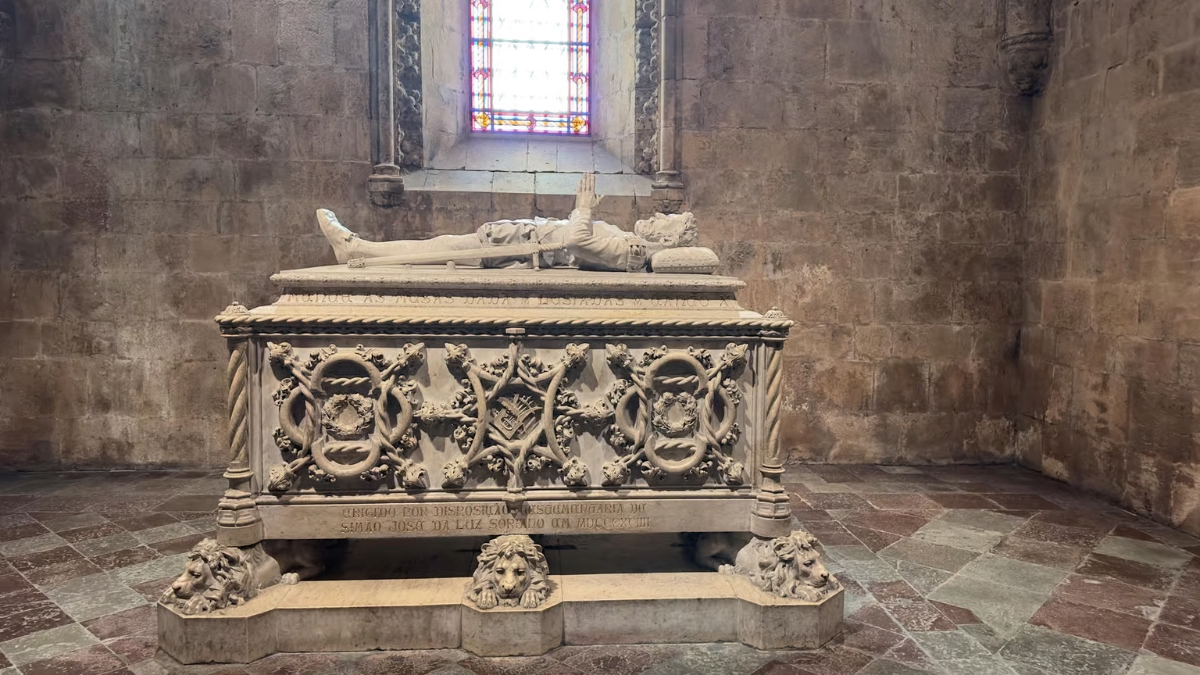
Jerónimos Monastery holds the tombs of navigator Vasco da Gama and national poet Luís de Camões, carved in ornate 19th-century Neo-Manueline style and set on either side of the free church’s entrance. The main chapel houses Portugal’s royal pantheon, with the tombs of King Manuel I and King João III and their queens. Poet Fernando Pessoa’s tomb sits in the cloister, and historian Alexandre Herculano is buried in the chapter house. The church tombs cost nothing to see; the cloister and chapter house require the paid ticket.
Few churches anywhere gather so many figures from a single national story under one roof. At Jerónimos, a navigator who opened a sea route to India, the poet who turned that voyage into an epic, two kings who built the empire it funded, a modernist poet, and a 19th-century historian are all buried or commemorated within a few hundred meters of each other.
This guide sets out exactly who is where, why each of them ended up at Jerónimos, and which tombs are free to see versus which sit inside the ticketed areas.
Vasco da Gama’s Tomb
Vasco da Gama, the navigator whose 1497–1499 voyage opened the sea route from Europe to India, is entombed in an ornate carved tomb just inside the church, near the main entrance. The tomb itself is a 19th-century Neo-Manueline creation, added long after his death, and some historians have questioned whether the remains transferred into it were correctly identified.
Vasco da Gama is the reason Jerónimos exists in the form it does: Manuel I built the monastery, in large part, to give thanks for the trade route da Gama’s voyage unlocked. Da Gama died in Kochi, India, in 1524, and his remains were eventually brought back to Portugal and buried at a convent in Vidigueira. In 1880, to mark the anniversary of his voyage, his remains were moved to a specially carved tomb at Jerónimos, resting on a base decorated with rope, armillary spheres and other maritime motifs typical of the Manueline style being revived at the time.
It’s worth being honest about the tomb itself: despite its medieval-looking carving, it dates from the 1890s rather than the 16th century, and it was designed to look older than it is. There has also been long-standing historical debate over whether the bones moved to Jerónimos in 1880 were definitively da Gama’s, since the identification relied on centuries-old parish records rather than direct evidence. Most visitors will never notice the difference, and the tomb remains the accepted resting place associated with him, but it’s not a settled certainty the way a modern DNA-verified burial would be.
Luís de Camões’ Tomb
Luís de Camões, Portugal’s national poet and author of the epic Os Lusíadas, has a matching ornate tomb on the opposite side of the church entrance from Vasco da Gama’s. Like da Gama’s tomb, it is a 19th-century Neo-Manueline creation, and in Camões’ case the uncertainty is greater: his original grave was lost, so the remains honored here cannot be confirmed as definitely his.
Camões wrote Os Lusíadas, the national epic that turned da Gama’s voyage into the founding myth of Portuguese identity, which is why the two men’s tombs face each other across the same church doorway — the explorer and the poet who immortalized him. Camões died in poverty in Lisbon in 1580 and was buried in a common grave at a convent that no longer exists, without a marked, individually identifiable resting place.
This is the point where honesty matters most: because Camões’ original grave was never properly recorded, the remains later honored as his and moved into the Jerónimos tomb cannot be verified as certainly his own. Historians have flagged this uncertainty for well over a century. The tomb is still the recognized place of homage to Camões and is treated as such by the Portuguese state, but it is a symbolic resting place more than a documented one. That distinction doesn’t make the tomb less worth seeing; it’s simply worth knowing before you stand in front of it.
The Royal Pantheon in the Main Chapel
The main chapel (capela-mor) of the church serves as a royal pantheon, holding the tombs of King Manuel I, who commissioned the monastery, and King João III, along with their queens. The tombs are elevated and rest on carved stone elephants, a detail unique among Portugal’s royal burials.
Walk past the tombs of da Gama and Camões toward the far end of the church and you reach the main chapel, where the founding king himself is buried. Manuel I, who ordered construction to begin in 1501, and his son and successor João III, who saw much of the building through to completion, both rest here alongside their queens. The tombs face each other across the chapel, each pair supported by carved stone elephants — an unusual and distinctly Manueline flourish that nods to the exotic world the maritime trade routes had opened up. Seeing the founding king buried inside the very building he commissioned is one of the quieter, more striking moments of a Jerónimos visit, and it costs nothing to take in, since the church is free.
Fernando Pessoa’s Tomb in the Cloister
Fernando Pessoa, one of the most important poets of the 20th century, has a modernist-style tomb (often described as a cenotaph) inside the ticketed cloister. His remains were moved here in 1985, on the 50th anniversary of his death, decades after he was originally buried in a Lisbon cemetery.
Pessoa died in 1935 and was first buried at the Prazeres cemetery in Lisbon. Fifty years later, in 1985, his remains were transferred to Jerónimos and given a monument inside the cloister — a striking contrast to the Manueline stonework around it, since the tomb is deliberately modern in style rather than an imitation of the older carving nearby. Because it sits inside the cloister rather than the free church, you’ll need a cloister ticket to see it, and it pairs naturally with a walk through the rest of the Royal Cloisters, the two-story carved courtyard most visitors come to Jerónimos for in the first place.
Alexandre Herculano’s Tomb in the Chapter House
Alexandre Herculano, the 19th-century historian and writer regarded as a founder of modern Portuguese historiography, is buried in the chapter house, part of the ticketed cloister complex. His 1880 transfer here made him one of the first non-royal figures honored with burial at Jerónimos.
Herculano died in 1877, and his remains were brought to the chapter house at Jerónimos in 1880, around the same period when da Gama’s remains were also moved into the church. His burial here reflects a 19th-century shift in how Jerónimos was used: no longer strictly a royal or religious resting place, but a kind of national pantheon honoring the figures Portugal wanted to remember, whether they wore a crown or not. The chapter house, a quieter, often overlooked corner of the cloister complex, is where you’ll find his tomb.
Finding the Tombs: A Quick Guide
| Who | Location | Free or Ticketed |
|---|---|---|
| Vasco da Gama | Church, flanking the main entrance | Free |
| Luís de Camões | Church, flanking the main entrance (opposite da Gama) | Free |
| King Manuel I, King João III & queens | Church, main chapel (capela-mor) | Free |
| Fernando Pessoa | Cloister, ground floor | Ticketed |
| Alexandre Herculano | Chapter house | Ticketed |
If you only have time for the free tombs, the church alone covers da Gama, Camões, and the royal pantheon — three of the five resting places on this list — without needing a ticket at all. Seeing Pessoa’s and Herculano’s tombs means budgeting time (and a ticket) for the cloister side of the complex, which is well worth it for the Manueline carving alone.
Free Church, Ticketed Cloister
Remember that the church of Santa Maria de Belém, where da Gama, Camões and the royal pantheon rest, is always free and has its own entrance and queue, separate from the ticketed cloister line. It also keeps shorter hours than the cloister and can close briefly for services, so if the tombs are your priority, don’t leave them for the very end of the day. Both parts of the monastery are closed on Mondays, so plan around that regardless of which tombs you’re visiting. Our guide to the church of Santa Maria de Belém covers the rest of what to see inside, and the history of Jerónimos Monastery explains how the building came to hold all of these figures in the first place.
Frequently Asked Questions
Who is buried at Jerónimos Monastery?
The church holds the tombs of navigator Vasco da Gama, poet Luís de Camões, and the royal pantheon of King Manuel I, King João III and their queens. In the ticketed cloister complex, poet Fernando Pessoa is buried in the cloister and historian Alexandre Herculano in the chapter house.
Are Vasco da Gama’s remains really in his tomb at Jerónimos?
Most likely, though not with absolute certainty. His remains were moved from Vidigueira to a newly carved tomb at Jerónimos in 1880, based on parish records rather than direct proof, and some historians have questioned whether the identification was fully accurate. The tomb remains the accepted, official resting place associated with him.
Are Luís de Camões’ remains really in his tomb?
This is genuinely uncertain. Camões was originally buried in a common grave that was later lost, so the remains honored in his Jerónimos tomb cannot be confirmed as definitely his. The tomb functions as Portugal’s official place of homage to him, but historians have long noted the identification is symbolic rather than documented.
Are the tombs of Vasco da Gama and Camões original to the monastery?
No. Both tombs look Manueline but were actually carved in the 19th century, in the 1890s, in a Neo-Manueline style deliberately designed to match the surrounding architecture. The remains associated with each man were transferred into these newer tombs decades after the monastery itself was completed.
Which kings are buried at Jerónimos Monastery?
King Manuel I, who commissioned the monastery, and his son King João III are both buried in the main chapel, along with their queens. Their tombs are elevated and rest on carved stone elephants, a detail unique to these royal burials.
Is Fernando Pessoa buried at Jerónimos Monastery?
Yes. Pessoa was originally buried at Lisbon’s Prazeres cemetery after his death in 1935, and his remains were moved to a modernist-style tomb in the Jerónimos cloister in 1985, on the 50th anniversary of his death. Seeing it requires a cloister ticket, since it’s not in the free church.
Do I need a ticket to see the tombs at Jerónimos?
Not for all of them. The church, where da Gama, Camões and the royal pantheon rest, is free to enter through its own separate entrance. Fernando Pessoa’s tomb in the cloister and Alexandre Herculano’s tomb in the chapter house are both inside the ticketed cloister complex.
Where exactly are the tombs located inside Jerónimos?
Da Gama’s and Camões’ tombs flank the church entrance on either side, and the royal pantheon is in the main chapel at the far end of the church. Pessoa’s tomb is on the ground floor of the cloister, and Herculano’s is in the chapter house, a side room off the cloister.
