
Jerónimos Monastery History: Who Built It & Why It Matters
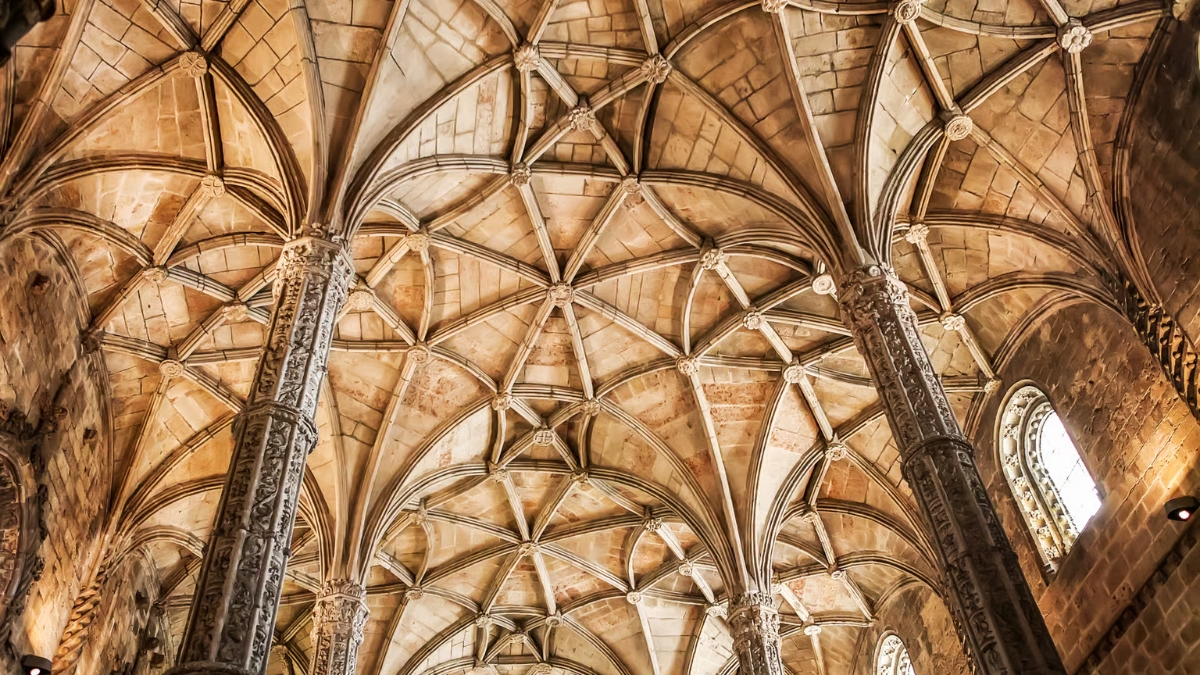
Jerónimos Monastery was commissioned by King Manuel I and begun in 1501 on the site of an earlier chapel where Vasco da Gama reportedly prayed before sailing to India. Built largely with proceeds from the spice trade and handed to the Order of St Jerome, it took roughly a century to complete and stands today as the finest expression of Manueline art and Portugal’s maritime empire. It survived the 1755 Lisbon earthquake and was named a UNESCO World Heritage Site in 1983.
Few buildings tell a nation’s story as directly as Jerónimos Monastery. Every carved rope, coral and armillary sphere on its walls points back to the ships that once left the Tagus for unknown seas, and the monastery itself was built, quite literally, on the profits of that voyage.
This guide walks through who commissioned it, why it stands where it does, how it survived Lisbon’s worst disaster, and why historians and visitors alike still consider it a high point of Portuguese architecture.
A Chapel by the River, Before the Monastery
Before Jerónimos existed, a small chapel called Santa Maria de Belém stood on this riverbank, founded earlier in the 1400s under the patronage of Prince Henry the Navigator. It served sailors preparing to depart on Portugal’s early voyages, and Vasco da Gama and his crew reputedly spent their last night in prayer there before setting sail for India in 1497.
Long before Manuel I laid the monastery’s first stone, a modest hermitage dedicated to Santa Maria de Belém already occupied this spot at the mouth of the Tagus. It had been founded under the patronage of Henry the Navigator, the prince whose sponsorship of exploration set Portugal’s Age of Discovery in motion, and it was run by monks who tended to sailors about to head out to sea. That detail matters: this stretch of riverbank was already associated with departure, prayer and uncertainty long before it became a royal monument.
The chapel’s most famous association is with Vasco da Gama. According to long-standing tradition, da Gama and his crew kept vigil there on the night before their fleet departed in 1497 on the voyage that would open the sea route to India. Whether or not every detail of that night survives in exact record, the association between this site and Portugal’s most consequential voyage is well established, and it’s the reason Manuel I chose to build here rather than elsewhere.
Manuel I’s Monument to a Golden Age
King Manuel I ordered construction to begin in 1501, on the same ground as the old chapel, as a monument to the wealth and prestige that da Gama’s route to India had unlocked. It was funded largely through what became known as the “pepper tax” — a share of the revenue from spices, pepper and other goods flowing in from the new maritime trade routes. In effect, the monastery was built with the profits of the very voyage it commemorates, which is part of why it reads less like an ordinary church and more like a national trophy carved in limestone.
Manuel entrusted the finished monastery to the Order of St Jerome, the Hieronymite monks from whom it takes its name (Mosteiro dos Jerónimos). Their role was to pray for the king’s soul and for the souls of the sailors who set out from Belém, continuing the same spirit of protection and blessing that the earlier chapel had offered.
Two Architects, One Century of Building
Construction stretched across roughly a hundred years and passed through the hands of several master builders, but two names dominate the story. Diogo de Boitaca began the project, laying out the ambitious Manueline cloister and setting the decorative vocabulary — ropes, knots, coral, and maritime symbols carved directly into stone — that defines the building. João de Castilho took over construction in the 1510s and carried it further, adding the more sculptural south portal and pushing the ornamentation to new heights before the church and cloisters were substantially complete. You can see the full range of that decorative language up close in our guide to the Manueline architecture at Jerónimos.
The result of that long build is a complex with two distinct parts still visible today: the free church of Santa Maria de Belém, and the ticketed cloisters, the two-story carved courtyard that most visitors come specifically to see.
Royal Tombs and a National Resting Place
As the monastery took shape, it also became a resting place for figures central to the story it tells. Vasco da Gama himself is entombed just inside the church, near the poet Luís de Camões, whose epic poem Os Lusíadas immortalized the voyages the monastery celebrates. Kings Manuel I and João III and other members of the royal family are also buried within the church. Our guide to the tombs at Jerónimos covers who is buried where and what to look for.
Surviving Lisbon’s Greatest Disaster
The 1755 Lisbon earthquake destroyed much of the city, but Jerónimos Monastery survived largely intact. Its solid Manueline construction is generally credited with helping it withstand the shaking that leveled so many other Lisbon landmarks that day.
On 1 November 1755, an enormous earthquake, followed by fires and a tsunami, devastated Lisbon and killed tens of thousands of people. Much of the medieval and Renaissance city was reduced to rubble. Jerónimos Monastery, remarkably, came through largely intact, a fact often cited as evidence of the strength of its construction and one of the reasons so much of its original Manueline stonework survives to be seen today.
Dissolution, New Uses, and Recognition
The monastery’s religious life did not last forever. In 1834, following Portugal’s civil conflicts, the government dissolved the country’s religious orders, and the Hieronymite monks left Jerónimos for good. For a time afterward the buildings were put to more practical use, including as a school, before the 19th century brought a wave of restoration that celebrated the monastery as a symbol of national history and returned it to prominence as one of Portugal’s great monuments.
That prominence was formally recognized in 1983, when UNESCO inscribed Jerónimos Monastery as a World Heritage Site jointly with the nearby Belém Tower, citing it as an outstanding example of Manueline art tied to Portugal’s age of maritime expansion.
Why Jerónimos Monastery Matters
Jerónimos matters for two reasons that reinforce each other. Architecturally, it is widely regarded as the high point of the Manueline style, the uniquely Portuguese strain of Late Gothic ornament that fuses religious imagery with maritime motifs found nowhere else at this scale. Historically, it stands as the clearest physical symbol of Portugal’s Age of Discovery: commissioned with money earned from the spice trade, built on the site where sailors prayed before facing the unknown, and dedicated to giving thanks for a voyage that changed the shape of the known world. Few buildings anywhere combine artistic ambition and national memory quite so directly. For the church interior itself, see our guide to the church of Santa Maria de Belém.
Frequently Asked Questions
Who built Jerónimos Monastery?
King Manuel I commissioned the monastery, with construction beginning in 1501. The building work was carried out under two principal architects, Diogo de Boitaca and later João de Castilho, and continued under later masters for roughly a century until it was substantially complete.
Why was Jerónimos Monastery built?
It was built to give thanks for Portugal’s maritime discoveries, especially Vasco da Gama’s 1497–1499 voyage to India, and to replace an earlier chapel on the same site where sailors had prayed before departing. It also served as a monument to the wealth and prestige the spice trade brought to Portugal under Manuel I.
What was on the site before the monastery?
A small chapel dedicated to Santa Maria de Belém stood there earlier, founded under the patronage of Henry the Navigator. It was used by sailors, and Vasco da Gama and his crew reputedly prayed there the night before their fleet departed in 1497.
How was Jerónimos Monastery funded?
Construction was funded largely through a tax on the spice trade, often called the “pepper tax,” which diverted a share of the profits from Portugal’s new maritime routes into the building project. This is one reason the monastery is so closely tied to the Age of Discovery.
Which religious order lived at Jerónimos?
The Order of St Jerome, known as the Hieronymites or Jerónimos, took charge of the monastery once it was built. They prayed for the king and for sailors setting out from Belém, and the monastery takes its name from them. They remained until religious orders were dissolved in Portugal in 1834.
Did Jerónimos Monastery survive the 1755 earthquake?
Yes. The 1755 Lisbon earthquake and its aftermath destroyed much of the city, but Jerónimos survived largely intact, a testament to the strength of its construction. That survival is part of why so much of the original Manueline stonework can still be seen today.
When did Jerónimos Monastery become a UNESCO World Heritage Site?
It was inscribed in 1983, jointly with the nearby Belém Tower, recognized for its outstanding Manueline architecture and its connection to Portugal’s age of maritime expansion.
Is Jerónimos Monastery still a working monastery today?
No. Religious orders were dissolved in Portugal in 1834, and the Hieronymite monks left at that time. The building is now a national monument, housing the church, the ticketed cloisters, and parts of two museums in its former west wing.
